Margot KYRIAKOS, a psychologist, is interested in the use of “simulation suits” in the training of healthcare professionals. These suits are designed to raise awareness of the functional impairments experienced by some older patients, which explain their difficulties in performing basic everyday tasks. The exercise involves wearing a weighted suit, along with equipment that impairs sensory perception, and then carrying out a series of tasks over a ten-minute period.
To understand the effects of the simulation suit, Margot KYRIAKOS conducted a workshop involving thirty-four healthcare assistant students, thirty of whom worked with older people. Before and after the exercise, participants were asked to indicate their perceived age on a line ranging from 0 to 120 years, with no intermediate age markers, and to provide a list of words they associated with ageing.
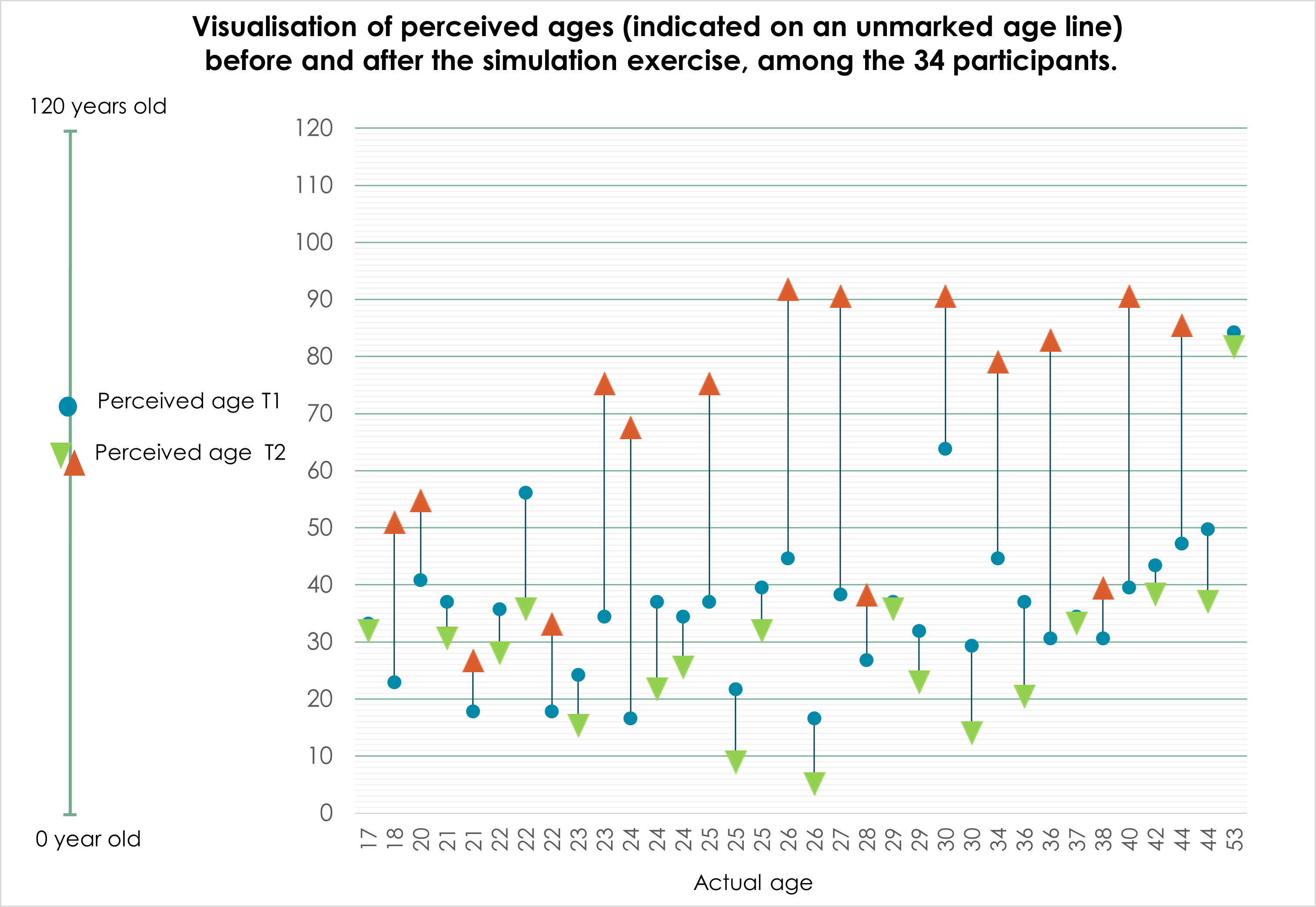
Before the simulation (T1), participants placed themselves on the line at an age higher than their actual age. After the simulation (T2), the mean perceived age increased further. However, this average masks two opposing patterns. Sixteen participants increased their perceived age, with ten placing themselves beyond the age of 65 or even 80, thereby distancing themselves from the “oldest old”, a stage of life associated with such difficulties. The remaining participants lowered their perceived age by a few years, reassessing their own position in relation to these difficulties. The words they associated with ageing increasingly focused on fatigue and functional limitations.
Although these responses cannot be directly attributed to the simulation suit, they suggest that awareness-raising can take different forms: distancing oneself from advanced old age, perceived as a stage at which difficulties accumulate; or gaining a new perspective on one’s own situation in relation to the difficulties experienced during the simulation. As a next step, it would be worth considering a discussion session to explore participants’ feelings about their role as caregivers and their professional practices when supporting people experiencing such difficulties.
* Study population: 34 health care assistant students, 2026.
How to read the figure: a 18-year-old participant placed its perceived age on the age line at 23 years old before the simulation, then increased it by 28 years old after the exercise.
Statut : Doctorante en psychologie
Affiliations :
- Centre d'Études et de Recherche en Psychopathologie et Psychologie de la Santé, CERPPS,
- École doctorale CLESCO, Université Toulouse Jean Jaurès. Financement : contrat doctoral