Image
Source : Base Retraités, Cnav
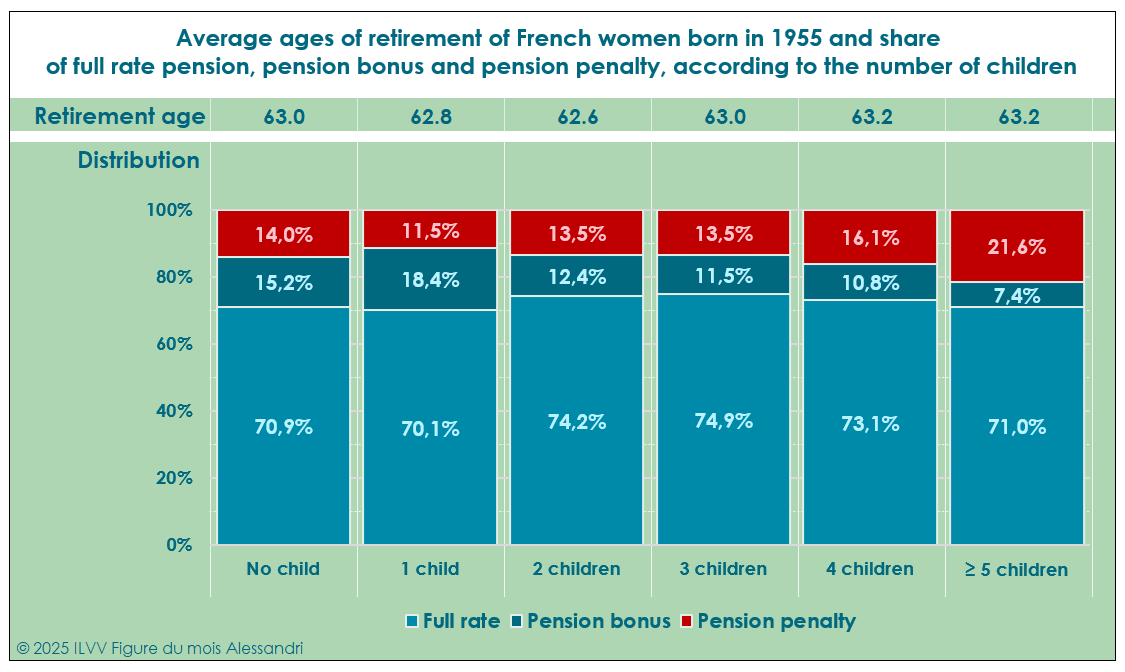
Population: 357 375 born in 1955, having claim their pension between 2003 and 2023 (living in France at this date; the legal age was 62 years old
Read : 71% of mothers of 5 children or more benefited a full rate pension, 7% a pension bonus, 22% had a pension penalty due to insufficient total number of contribution quarters (worked and credited) and retired before the age at which penalty is cancelled (67 years old)
Caroline ALESSANDRI, a demographer, examines the factors shaping retirement intentions and behaviors, with particular attention to family size. Because some mothers experience career interruptions, retirement may be accompanied by a reduced pension when the required number of contribution quarters has not been reached. To limit this risk, the French pension system grants credited quarters associated with childbirth.
Drawing on data from the National Old-Age Insurance Fund (Caisse nationale d’assurance vieillesse), Caroline ALESSANDRI analyzes the diversity of retirement conditions among women born in 1955 who claimed their pension rights between 2003 and 2023. She distinguishes between those who retired at the full rate, those who faced a pension penalty, and those who benefited a pension bonus (i.e. retiring after the penalty-free age, with more contribution quarters than required, including credited quarters).
The average retirement age is 63.2 years among mothers of five or more children. However, this group also shows the highest rate of pension penalty (22%), twice the level observed among mothers of one child. The latter retire at an average age of 62.8 years and are the most likely to receive a pension bonus (18%). This proportion declines steadily as family size increases, falling to 7% among mothers of five or more children. These women were less likely to reach the required number of contribution quarters (or to wait until the penalty-free age) and less likely to extend their careers beyond this threshold.
With the same average retirement age, childless women exhibit the same rate of pension penalty as mothers of three children, but a higher rate of pension bonus. Overall, despite the credited quarters granted to mothers born in 1955, pension penalty become more frequent from the second child onward, while pension bonus become less common.
Statut : Post-doctorante en épidémiologie, Cheffe de projet
Affiliation : équipe ACTIVE, INSEERM U1219, Bordeaux Population Health