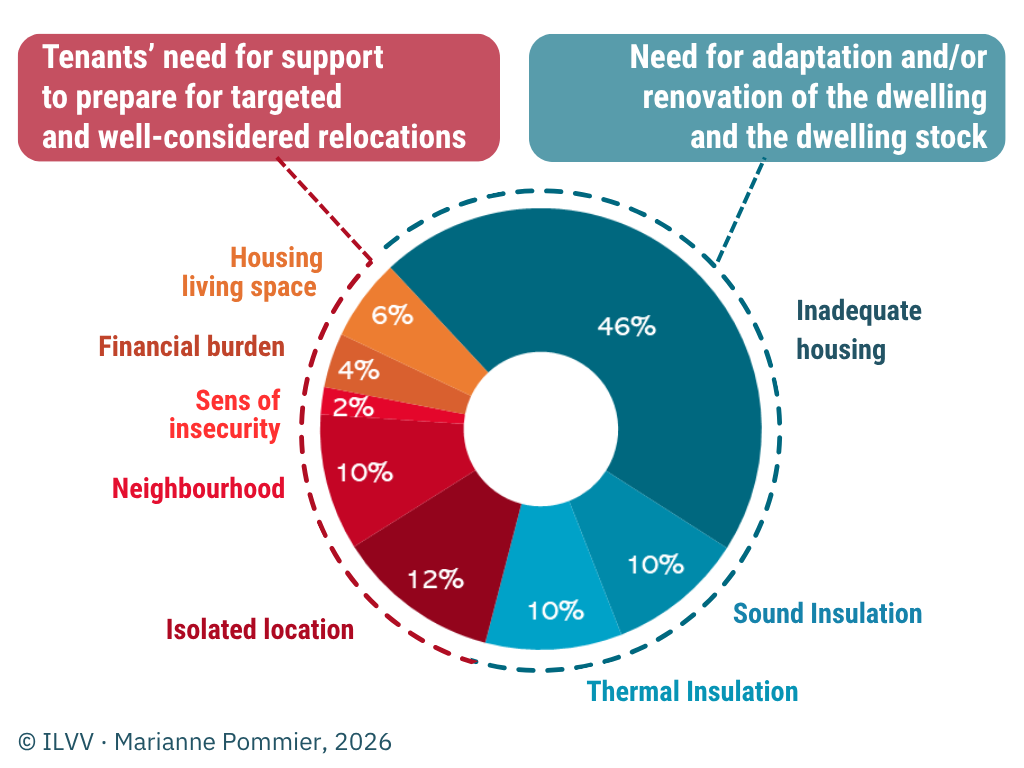
Reasons for relocation requests reported by social housing tenants
According to the type of needs addressed to social landlords
Marianne POMMIER, architect, focuses on older tenants in public housing. She studies the dynamics of housing appropriation, attachment, and adaptation – as well as their ties to the local communities. In this context, she explores the reasons that lead them to request a relocation, even at the risk of losing their local networks – whether social, medical, or related to every day life.
She draws on a survey conducted in 2026 among 1881 OPH31 tenants aged 50 and older. According to the 363 valid questionnaires, four out of ten respondents are considering moving. By analyzing the motives given, Marianne POMMIER sheds light on the role that the social landlords could play in adapting their dwelling stock as well as their practices towards aging residents.
The vast majority of requests relate to building features: the most common reason, “inadequate housing” (46%), reflects a mismatch between dwelling’s facilities (bathtub, restroom) or the layout (no elevator) and the person’s abilities; thermal (10%) and sound (10%) insulation indicating discomfort in every day uses. Measures to adapt or renovate the existing dwelling stock – which would benefit all residents – would help limit the need for relocation.
Other reasons depend on circumstances specific to the tenant: for example, those related to geographic location, an excessive financial burden, or a living space exceeding the actual needs. In such cases, the goal would be to facilitate targeted and well-considered relocations; the social landlord could provide administrative and social support to help tenants anticipate and organize.
The aging of social housing tenants compels landlords to fulfill their mission of preserving and improving living and aging conditions in social housing. In addition to ensuring that housing is appropriate for older adults’ needs, the internal “senior policies” could focus on improving the conditions under which tenants relocate.
Statut : Doctorante en architecture
Affiliations :
- LRA (Laboratoire de Recherche en Architecture), Toulouse
- GRIEF (Groupe de Recherche sur l’Invention et l’Évolution des Formes), Rennes
- Université Toulouse 2
- CIFRE OPH31
Publications :
- Courbebaisse, Audrey, et Marianne Pommier. 2020. « Vieillir chez soi. Formes spatiales et sociales propices au maintien à domicile des personnes âgées dans les grands ensembles, le cas toulousain ». Les Cahiers de la recherche architecturale urbaine et paysagère, nᵒ 8 (novembre): 8. https://doi.org/10.4000/craup.5077.
Titre de la thèse :
- Vieillissement des habitants dans le parc social existant : entre appropriations, attachement, et besoin d’adaptations des logements – analyse des réponses des bailleurs sociaux